AGIOne
Manufacturing
Ensuring AI Continuity in High-Dependency Environments with AGIOne
Context / Background
In many organisations, large language models have moved beyond experimentation into core operations. They now support customer service, content generation, sales workflows, and internal knowledge systems.
For a cross-border e-commerce enterprise, this shift was already well underway. AI was embedded across critical functions, including 24/7 customer support, multilingual product content creation, marketing asset generation, after-sales ticket routing, and internal knowledge assistance.
At a glance, everything worked seamlessly. Which made one assumption easy to overlook: the model would always be available.
Challenge
This assumption was tested during a major promotional period. The organisation relied heavily on a single closed-source model. While performance had been strong, it also created a hidden dependency. When the model’s API experienced instability just hours before a peak sales event, the impact was immediate.
Customer service response times slowed.
Multilingual content production was delayed.
After-sales tickets began to accumulate.
Internal teams lost access to AI-assisted workflows.
Within hours, operational efficiency dropped across multiple departments. This was not a failure of AI capability. It was a failure of resilience. The organisation realised that relying on a single model meant tying business continuity to an external, uncontrollable variable.
Approach / Solution
To address this risk, the company implemented AGIOne as a unified model orchestration and management platform.
Instead of depending on a single provider, the enterprise restructured its AI foundation to include:
Multiple leading closed-source models
Open-source models hosted in public cloud environments
Privately deployed models within internal infrastructure
AGIOne introduced an intelligent routing layer that dynamically selects the most appropriate model for each request based on:
Task complexity
Latency requirements
Cost considerations
Compliance constraints
Real-time availability
When a primary model becomes unavailable or degraded, the system automatically switches to alternative models. This ensures that critical workflows such as customer service, content generation, and internal assistance continue without interruption.
Outcome / Value
Following the implementation, the organisation achieved a more stable and controllable AI operating model.
Key improvements included:
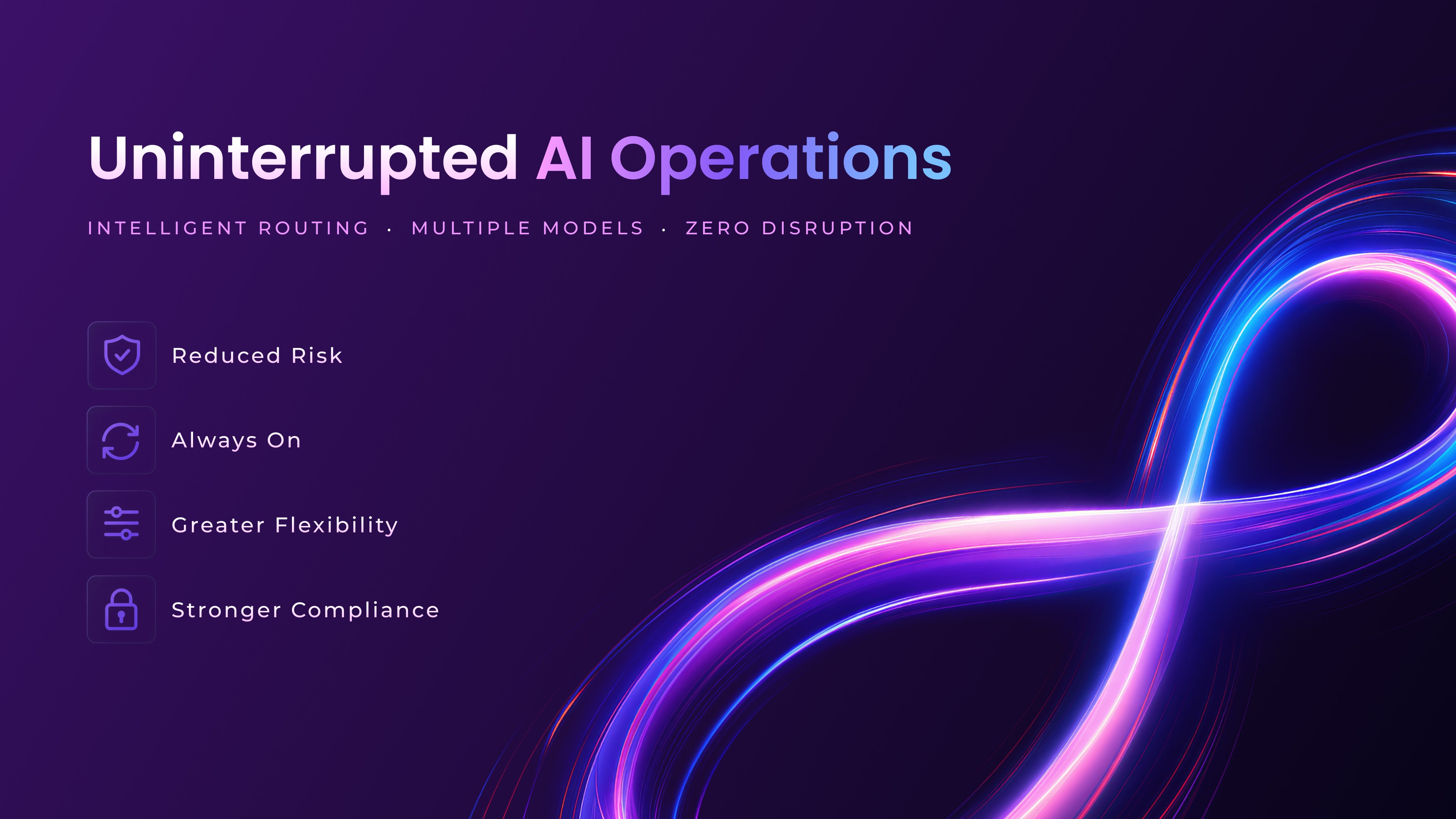
Reduced risk of service disruption during peak periods
Continued operation of core AI-driven workflows despite external model issues
Greater flexibility in balancing performance, cost, and speed
Improved alignment with data security and compliance requirements
More importantly, AI shifted from being a convenient tool to a managed capability within the organisation’s infrastructure.
This change addressed a fundamental gap: not how to use AI, but how to rely on it safely.
Closing Insight
As enterprises deepen their reliance on AI, the conversation is shifting.
The question is no longer whether AI can improve efficiency, but whether it can be trusted to operate consistently under pressure.
This case reflects a broader reality. A powerful model alone is not enough. Without resilience, even the best-performing AI becomes a point of risk.
AGIOne addresses this by introducing structure, flexibility, and continuity into how models are used.
Connecting AI to the business is only the first step. Building it into reliable infrastructure is what comes next.