AGIOne
Education
AI Workflow Continuity Through Model Resilience
Context
As large language models become embedded in enterprise operations, their role has moved well beyond simple interactions.
They now sit inside multi-step workflows, handling tasks such as interpreting inputs, identifying intent, orchestrating actions, invoking tools, and generating outputs. These workflows increasingly support core business functions, where consistency and reliability matter as much as accuracy.
This shift changes AI from a capability into an operational dependency.
Challenge
While model-driven workflows improve efficiency, they also introduce a new layer of fragility.
In real-world environments, several patterns tend to emerge:
Multi-step workflows amplify the impact of single-point failures
No single model consistently balances quality, latency, and reliability
Under peak load or complex scenarios, models may timeout, fail, or become unavailable
Outputs may vary in structure or completeness, disrupting downstream processes
Without validation and fallback, errors can propagate across the workflow
In this context, relying on a single model or a fixed execution path creates operational risk. When one step fails, the entire workflow can stall or degrade.
Approach
AGIOne introduces a model resilience framework designed for multi-step AI workflows.
Rather than treating model calls as isolated events, they are managed as part of a controlled and observable execution chain.
Key capabilities include:
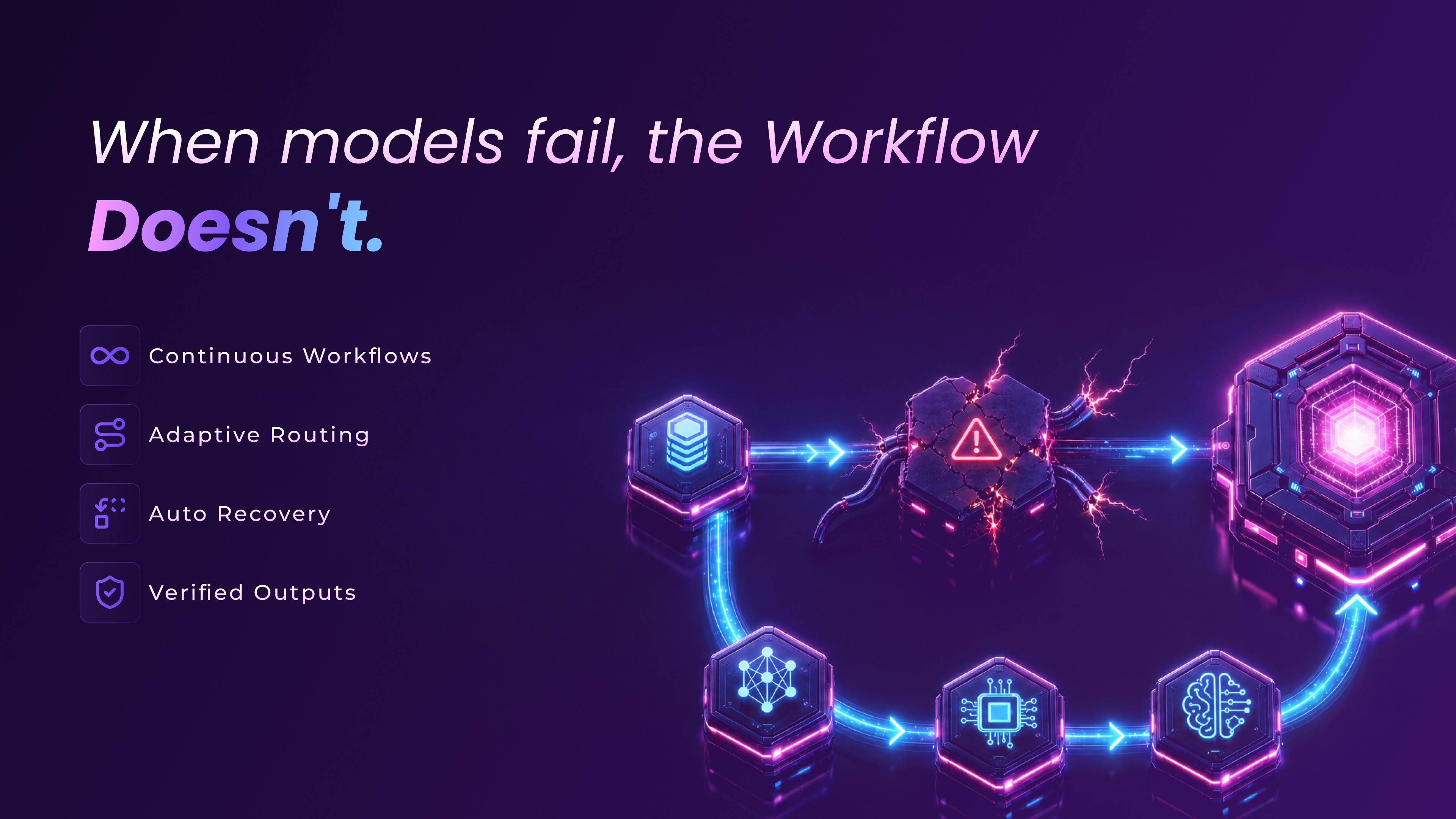
Adaptive model routing Each request is directed to the most suitable model based on task type and requirements
Multi-model coordination Different models work together to balance quality, response time, and cost
Automatic failover When a model fails, times out, or is rate-limited, the system switches seamlessly
Output validation Responses are checked for structure, format, and key content before moving forward
Fallback and recovery mechanisms The system can retry, switch models, or apply fallback logic when outputs are not usable
End-to-end observability Model behaviour, switching decisions, and outcomes are tracked for optimisation
This shifts the design from relying on individual model success to managing uncertainty across the entire workflow.
Outcome
In controlled simulation scenarios, including timeouts, model errors, and output inconsistencies:
Workflows continued even when individual model calls failed
Multi-model strategies proved more stable than single-model dependency
Validation and fallback reduced the impact of abnormal outputs
Automatic switching lowered the need for manual intervention
Overall workflow stability improved under load and complexity
Closing Insight
In enterprise AI systems, instability is not an exception — it is something to design for.
The goal is not to ensure every model call succeeds.
The goal is to ensure the system continues to operate when they don’t.
That distinction is what makes AI usable in real business environments.